Asia-Pacific Regional Forum on Teachers 2026
Asia-Pacific Regional Forum on Teachers 2026: Advancing Investment, Equity, and Professional Support Across the Region
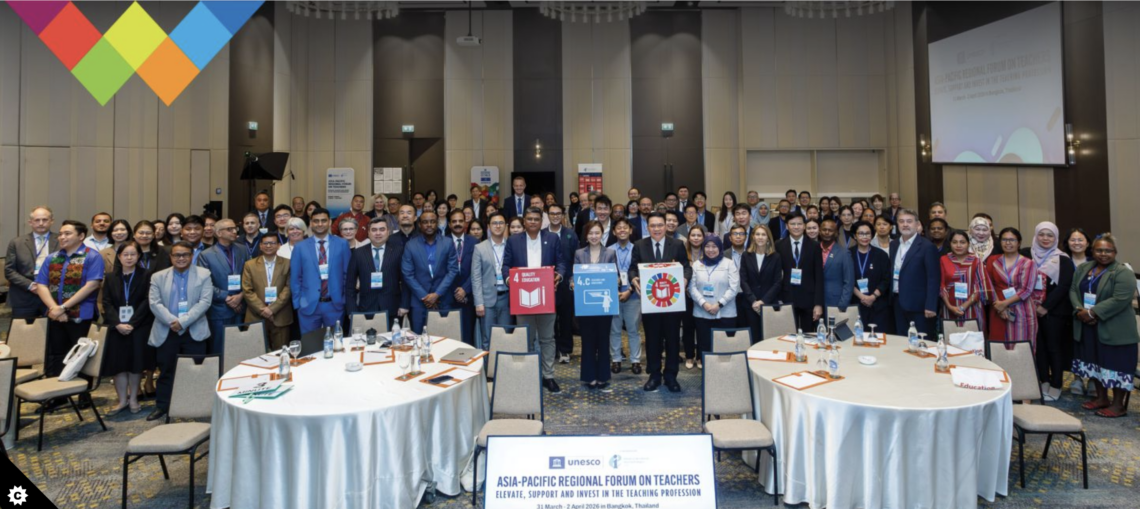
The Asia-Pacific Regional Forum on Teachers, held from 31 March to 2 April 2026 at the Avani Sukhumvit Bangkok Hotel, brought together education leaders, policymakers, and teaching professionals at a critical juncture for global education systems. Organised by UNESCO Bangkok in partnership with Education International Asia-Pacific, the forum focused on translating global commitments into practical regional strategies to strengthen the teaching profession.
Positioned as a follow-up to the World Summit on Teachers 2025, the Bangkok meeting reflected growing urgency across the Asia-Pacific region to address teacher shortages, improve working conditions, and elevate the status of educators within rapidly evolving education systems.


Around 120 participants from across Asia-Pacific attended the forum, representing ministries of education, teacher unions, international organisations, and policy institutions. The relatively focused scale of the event enabled in-depth dialogue and practical exchanges, with sessions designed to move beyond policy discussion towards implementation frameworks.
A central theme throughout the forum was the need to reposition teachers as core agents of change within education reform. Discussions highlighted that improving learning outcomes cannot be separated from investment in teachers themselves, particularly in areas such as recruitment, retention, and continuous professional development. Delegates emphasised that teacher shortages—especially in rural and underserved communities—remain one of the most significant barriers to equitable education across the region.
One of the key case studies presented came from Thailand’s Equitable Education Fund, which showcased its “Homegrown Teachers” initiative. The programme is designed to recruit and train teachers from within local communities, particularly in remote and disadvantaged areas. By developing educators who are already embedded within their communities, the initiative addresses both teacher shortages and retention challenges, while also improving cultural and contextual relevance in the classroom.
The model aligns closely with findings from the Global Education Monitoring Report 2026, which underscores the importance of equity-driven policies and localised solutions in addressing systemic gaps in education access. The Thai example was highlighted as a scalable approach that could be adapted across other countries facing similar geographic and socio-economic challenges.
Across multiple sessions, four priority areas consistently emerged. Elevating the status of the teaching profession was identified as fundamental, with participants noting that public perception, compensation, and career progression pathways all play a role in attracting new entrants. Increased and sustained investment in education systems was also emphasised, particularly in ensuring that funding reaches frontline teaching environments.
Professional development formed another key pillar of discussion. Delegates stressed that ongoing training must be practical, accessible, and aligned with evolving classroom needs, including digital competencies and inclusive teaching practices. At the same time, there was a strong focus on teacher wellbeing, with recognition that workload, administrative burden, and mental health pressures are increasingly impacting retention rates.
The forum concluded with a shared commitment among participants to strengthen education systems through coordinated regional action. While no single policy framework was prescribed, the emphasis was placed on collaboration—between governments, international organisations, and teacher networks—to implement solutions that are both context-specific and scalable.
Importantly, the event reinforced the role of regional platforms in bridging global policy and local implementation. By aligning discussions with the outcomes of the Santiago Consensus, the forum demonstrated how international agreements can be translated into actionable strategies that respond to the realities of individual countries.
Held in a Category VIII (Symposia) in-person format with English as the working language, the Bangkok forum also highlighted the continued importance of face-to-face engagement in addressing complex, systemic challenges within education.
As education systems across the Asia-Pacific region continue to navigate post-pandemic recovery, demographic shifts, and technological transformation, the outcomes of this forum underline a clear message: meaningful reform depends on sustained investment in teachers—not only as educators, but as the foundation of resilient and inclusive learning systems.